What Is Your Real Hourly Rate, and Why Most Bookkeepers Have Never Actually Calculated It
You know your posted rate. You probably have it memorized. It's the number you quote on discovery calls, the one on your services page, the number clients see when they're deciding whether to hire you.
But there's another number that tells the real story of your practice. Most bookkeepers have never actually calculated it, and in a lot of cases, that's because no one has ever clearly explained what it is or why it matters. Some avoid it because they suspect the result will be uncomfortable. Both are understandable. Neither makes the gap go away.
That number is your real effective hourly rate. It's the figure that reflects what you're actually earning per hour once everything is accounted for, not just the work you invoiced, but the work you did. Once you see it, you can't unsee it. And more importantly, once you understand it, you have something concrete to work with.

What your real hourly rate actually measures
Your posted rate is what clients pay per hour, or what your packages imply per hour. Your real effective hourly rate is something different. It's what you actually take home per hour once you account for all the time you worked, not just the time you billed.
That distinction matters because a significant portion of the work in a bookkeeping practice is never invoiced. Responding to client emails, fixing something that fell outside the original scope, switching between client files, following up on missing documents, handling your own admin: all of that takes real time. It just doesn't appear on an invoice. Which means when you divide your income by your actual hours, the number is lower than your posted rate implies. Often meaningfully lower.
At a deeper level, your real hourly rate also accounts for your business expenses and your actual working year. Software subscriptions, QuickBooks seats, insurance, professional development; those costs come out of your revenue before you keep anything. And the weeks you don't work (holidays, sick days, the slower weeks that come with running a solo practice) reduce your total annual hours without reducing your fixed costs. Factor all of that in, and the picture changes considerably.
The result is a number that reflects the true profitability of your time. And for most bookkeepers who run this calculation for the first time, it's lower than they expected.
Why it matters more than your posted rate
Your posted rate tells you what clients think they're paying. Your real hourly rate tells you what you're actually earning. The gap between those two numbers is where most of the frustration in a solo bookkeeping practice lives.
It's the reason you can be consistently booked and still feel like you're not getting ahead. It's the reason a rate increase sometimes doesn't change how things feel. And it's the reason "just get more clients" almost never solves the underlying problem, because if the structure of the practice is leaking, more volume just means more leaking.
Your real hourly rate reveals a few things that your posted rate never will.
It shows you what you're actually taking home. You might invoice at $70 per hour, but once unbilled time and business expenses are factored in, that number can drop by $20, $30, even $40 per hour. The invoiced rate and the kept rate are two very different things, and most bookkeepers are operating on the assumption that they're roughly the same.
It exposes where your time is going. Every "quick question," every scope-adjacent task you absorb, every email thread that takes 20 minutes and never gets billed; it all adds up to real hours you worked and weren't compensated for. The effective rate makes that visible in a way that vague frustration doesn't.
It explains why the math doesn't seem to work. If your practice feels like it should be performing better than it does, your real hourly rate is often where the answer lives. Not in your motivation, not in your skill level, not in your rates alone. In the structure.
One thing worth saying clearly: raising your rates or taking on more clients won't fix this on its own. If the underlying structure of your practice hasn't changed, your real hourly rate almost certainly hasn't either. A higher posted rate applied to the same leaky structure produces a slightly higher effective rate, but the gap persists. The structure is what needs to change, and you can't design that change until you know what your numbers actually look like.

What this looks like with real numbers
Let's make this concrete.
A bookkeeper charges $65 per hour and invoices for 25 billable hours per week. On paper, her practice looks healthy. That's $1,625 per week, or roughly $75,000 per year before expenses and taxes.
But when you look at the full picture, it changes. She also spends about 10 hours per week on unbilled work: client emails, admin, her own bookkeeping, onboarding tasks, and the occasional cleanup that didn't make it onto an invoice. She takes four weeks off per year. Her monthly software and insurance costs run around $400.
Run those numbers properly: total take-home after expenses and estimated taxes, divided by total hours worked across actual working weeks, and her real effective hourly rate lands somewhere between $34 and $40 per hour, depending on her tax situation.
Same practice. Same clients. Same effort. Completely different reality.
This is why competent, experienced bookkeepers can feel like they're doing everything right and still not getting ahead. The problem almost never comes down to skill or work ethic. It comes down to structure: the way time is tracked (or not tracked), the way scope is defined (or not defined), and the way pricing was originally built, usually on optimistic assumptions about how the work would actually flow.
The effective rate is what makes that visible. It turns "something feels off" into a specific number you can actually do something with.
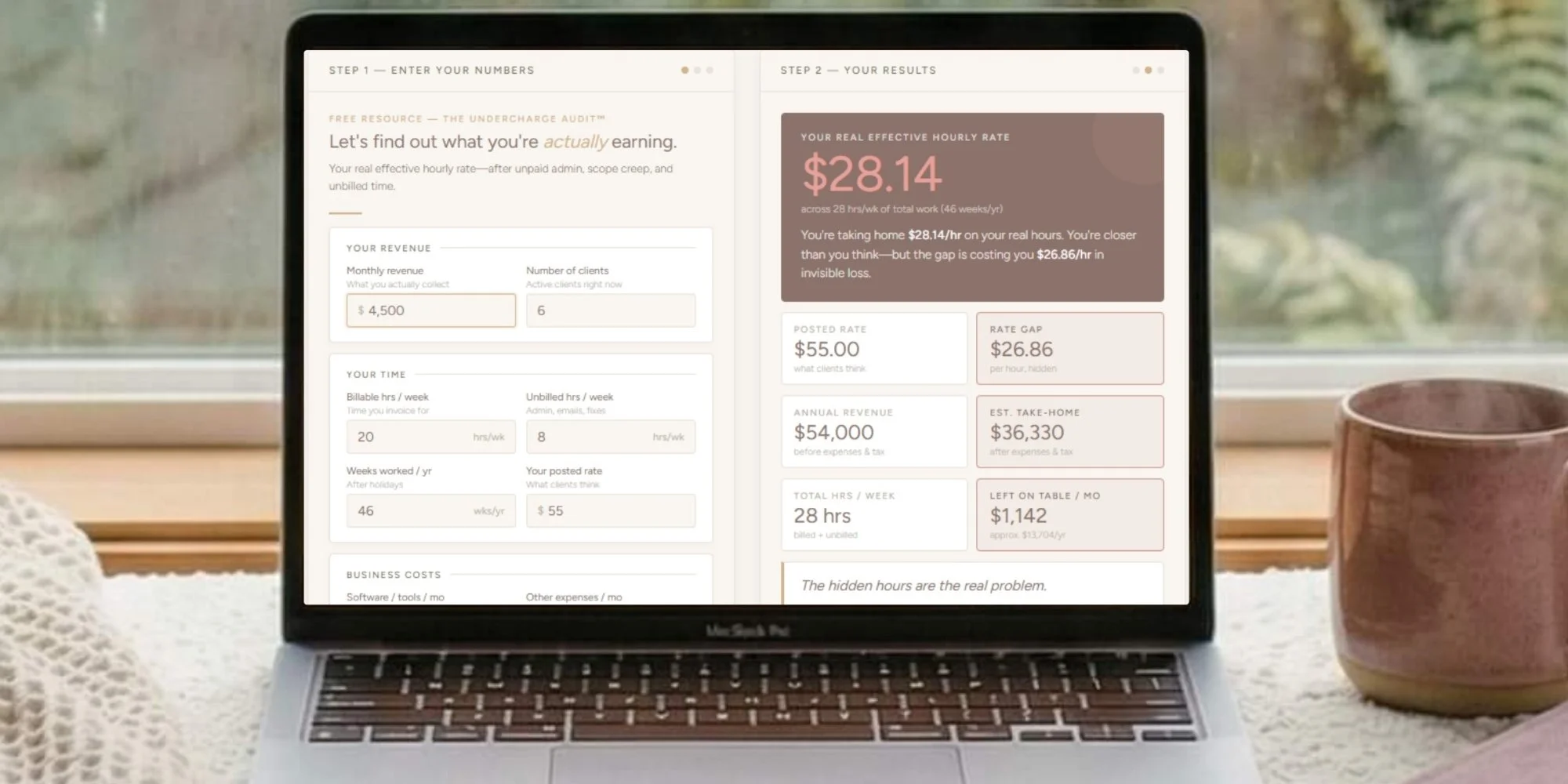
Run your numbers before you go any further
If you want to skip straight to seeing your own number, there's a free tool built for exactly this.
The Undercharge Audit calculates your real effective hourly rate in about five minutes. You enter your monthly revenue, your client count, your billable and unbilled hours per week, your business expenses, and the number of weeks you actually work each year. The tool runs the math and shows you your effective rate, the gap between that and your posted rate, and how much you may be leaving on the table each month.
Most bookkeepers find the result genuinely surprising. That's the point. A vague sense that something is off doesn't move you to act. A specific dollar figure usually does.
Three things worth paying attention to once you know your number
Knowing your real hourly rate is the starting point. What you do with it depends on where the gap is coming from, but there are three places worth looking first regardless of what your number reveals.
Track your unbilled time, even roughly. You don't need a sophisticated time-tracking system to start building awareness here. Even a rough count of how many hours per week you spend on work that never makes it onto an invoice will shift how you think about your capacity and your pricing. Most bookkeepers who do this for the first time are surprised by how high the number is. Five hours per week of unbilled work across 48 working weeks is 240 hours per year. At a $65 posted rate, that's $15,600 of labor that was performed but never collected on. The number gets attention in a way that "I feel like I'm always busy" doesn't.
Stop using your posted rate as a profitability benchmark. Your posted rate tells you what clients are paying. It doesn't tell you what you're keeping. Those are two genuinely different numbers, and conflating them is one of the most common ways bookkeepers end up underestimating the gap in their practice. Revenue is not profit. Invoiced rate is not take-home rate. Getting clear on that distinction is one of the more useful reframes in running a solo practice.
Calculate your actual rate, and do it with real numbers. This is the step most bookkeepers skip, usually because they're not sure how to run the calculation accurately, or because they suspect the result will be uncomfortable. Both are valid concerns. The Undercharge Audit handles the calculation so you don't have to build a spreadsheet, and it's worth doing even if, especially if, you're a little afraid of what you'll find. Discomfort with a number is information. Avoiding the number doesn't make the situation better; it just makes it harder to change.

What to do once you see it
Your real hourly rate is one of the most honest metrics in your practice. It reflects how your time, your pricing, and your systems are actually working together, and it's often the clearest explanation for why things feel the way they feel.
If the number is lower than you expected, that's useful. It tells you where to look: unbilled time, scope creep, business costs that were never factored into pricing, a working year that's shorter than the math assumed. Any one of those, addressed deliberately, improves the effective rate. All of them addressed together can change the character of the practice.
If the number is roughly where you expected, that's also useful. It confirms that your sense of things is calibrated, and gives you a baseline to measure against as you make changes going forward.
Either way, running on intuition and hoping the math works out is a harder way to run a practice than running on actual numbers. The Undercharge Audit is free, takes less than five minutes to complete, and gives you a clear picture of your real effective hourly rate, including how much you may be leaving on the table each month.