7 Reasons Your Bookkeeping Rate Feels Too Low (Even When Your Pricing Looks Fine)
You've set your rates. You have clients. On paper, things look okay.
You're not the cheapest bookkeeper out there. You've raised your prices at least once. Maybe you've moved to packages or value-based pricing, and for a while, that felt like progress. From the outside, it genuinely looks like you're doing everything right.
But the business still doesn't feel profitable. You're busy, often too busy, and the revenue doesn't seem to match what you're putting in. Month after month, you end up working more hours than you planned and taking home less than you expected. And somewhere in the back of your mind, you've started wondering whether you just need to charge more, or whether something else is going on.
That question is worth taking seriously. Because in most cases, the answer isn't a higher rate. Or at least, not only that.
Most bookkeepers who feel underpaid assume the number on their invoices is the problem. Raise the rate, fix the feeling. But that logic skips over everything that actually drives profitability, which is the structure underneath the rate. The way work is scoped, how time gets spent, what the business costs to run, whether your pricing model and your delivery process are actually compatible. Those things, more than the number itself, determine what you keep at the end of the month.
What follows are the seven patterns I see most often in solo bookkeeping practices that feel underpaid, even when the pricing looks reasonable from the outside.

1. Your pricing math is based on a version of this job that doesn't exist
When you set your rates, you probably estimated how long the core work would take, multiplied it out, and concluded it looked profitable. That math makes sense on paper.
The problem is it's based on a clean, uninterrupted version of bookkeeping work, and that version doesn't actually exist.
The real job includes the 20-minute email answering a client's "quick question" about a transaction. The chart of accounts cleanup you do quietly before closing the month because no one warned you it was a mess. The three follow-ups to track down a single missing receipt. The back-and-forth messages you absorb across a dozen small channels, none of which ever make it into an invoice.
Individually, each of those moments feels too small to count. And that's exactly why they're so easy to ignore when you're thinking about whether your rate is working. Collectively, they add up to several hours every week of real labor that was performed and never billed.
Your pricing is built on an estimate. But the work is built on reality. And the gap between those two things is where the profitability goes.
If you've never actually tracked how much unbilled time you're carrying, the Undercharge Audit is a good place to start. It runs the real math on your numbers and shows you your actual effective hourly rate in about five minutes.
2. Scope creep is expanding your workload without expanding your revenue
Scope creep in bookkeeping is rarely dramatic. It doesn't arrive as a client demanding something completely unreasonable. It arrives as small, politely worded requests that seem totally reasonable in the moment.
Can you pull a quick report while you're in there?
This is a one-time thing, I just need you to take a look.
While you're closing out the month, could you also...
You absorb these requests because you care about your clients and you want to maintain good relationships. Pushing back on something that small feels disproportionate. So you do it, and you tell yourself it's fine.
It is fine once. The problem is that once becomes a pattern, and a pattern becomes a standing expectation. And over time, without any formal renegotiation, your scope has grown significantly while your rate has stayed exactly the same.
What makes this particularly hard to catch is that scope creep rarely feels like scope creep while it's happening. It feels like being helpful. It feels like good client service, the kind that builds loyalty and trust. And in some ways it does build those things. The issue is that there's a real difference between being generous within a clearly defined engagement and being generous in place of one. The first is a choice you're making with full awareness. The second is something that happens to you gradually, without you ever agreeing to it.
Scope creep doesn't happen because bookkeepers are careless about their boundaries. It happens because bookkeepers are conscientious, and conscientiousness is genuinely expensive when it isn't protected by written agreements, defined deliverables, and a willingness to have the occasional uncomfortable conversation before the scope becomes something no one can walk back.
3. Your pricing model and your workflow weren't built to work together
Most bookkeepers choose a pricing structure and then figure out the workflow separately. They're treated as two distinct decisions. They're not.
How you charge directly shapes how work moves through your practice. A flat monthly retainer can be a genuinely profitable model when your scope is tightly defined and your delivery process is standardized. That same pricing model can quietly lose money every month when the work is inconsistent, expectations are vague, or there's no shared definition of what "complete" means.
Flat pricing rewards efficiency. If you can deliver excellent work in fewer hours than you estimated, you capture that margin. But if your process involves frequent rework, reactive communication, unclear handoffs, or clients who regularly go off-script, flat pricing punishes you for exactly those things. You absorb the cost of the chaos because the rate doesn't flex.
Hourly pricing has a different set of issues. It can feel safer because time is tracked, but it creates its own incentive problems and rarely scales the way bookkeepers expect.
The pricing structure and the delivery process have to be designed together, because they affect each other. Choosing a pricing model and then hoping your workflow adapts is one of the most reliable ways to end up quietly underpaid.

4. What's actually included has never been formally defined
This one requires an honest look at your engagement agreements, or the absence of them.
When client expectations and your actual agreement are two different things, and no one has ever stated the difference clearly, you end up carrying the gap. Every ambiguous request becomes something you absorb rather than something you redirect or price appropriately. Every assumption about what's included costs you time you weren't compensated for.
This happens most often with long-term clients, especially clients you've had from the beginning. Early on, you were generous because you were building the relationship and you weren't always sure what was reasonable. Over time, those early generosities became the baseline. Now the client believes that's just what's included, and you've never corrected that assumption, so from their perspective, there's nothing to correct.
The fix isn't complicated, but it does require a decision to be explicit about scope going forward. That means having clear written agreements that spell out what's included, what falls outside the engagement, and what the process is for work that doesn't fit neatly into either category. It means building a habit of reviewing scope when a client's needs change, rather than silently absorbing the difference. And it means getting comfortable with the occasional conversation where you explain that something is outside the current agreement, which almost always goes better than you expect it to.
Clear deliverables and clearly written scope protect the client relationship as much as they protect your time. Unspoken expectations are where resentment grows on both sides, even when both people believe they're acting in good faith. Defining scope isn't defensive. It's how you keep engagements clean and relationships intact over the long term.
5. Your business expenses are reducing your take-home more than you realize
Revenue and income are not the same number. Most bookkeepers know this, but it's easy to underestimate how much distance sits between the two, especially when expenses are small and scattered across different categories.
Consider what actually comes out before you keep a dollar: software subscriptions, QuickBooks seats for client files, professional development and CPE credits, bookkeeper-specific insurance, the cost of having your own books handled, and any tools or platforms you use to manage client communication and file sharing. Add those up across a year and the number is often larger than people expect, particularly because these costs tend to grow incrementally alongside the practice, one new tool at a time, without ever triggering a deliberate review.
Then there's the time question. As a solo operator, you don't have paid time off. Every week you don't work is a week without revenue, which means your actual working year is shorter than a calendar year. Holidays, sick days, the week you take off over the summer, the days you lose to the kind of low-grade exhaustion that comes from running everything alone — those all reduce your real annual hours. If your pricing was calculated based on 52 billable weeks, but you're actually working 44, you've already built a gap into the math before you've opened a single client file.
If those costs and those unpaid gaps weren't factored into your rates from the beginning, your pricing is built on incomplete math. You're not earning what the invoices suggest. You're earning what's left after the business takes its cut, and for a lot of solo bookkeepers, that number is noticeably lower than they'd calculated.

6. You're fully booked before you've built anything sustainable
There's a particular trap that solo bookkeepers fall into, and it's hard to see from inside it. You fill your capacity with client work because that's what pays. It feels responsible. It feels like growth. But once you're at capacity, you lose the margin of time you'd need to actually improve the practice.
You can't step back to evaluate which clients are profitable and which aren't. You can't build better systems or refine your onboarding process. You can't raise rates on underpriced clients without risking disruption at a moment when you have no bandwidth to manage it. You can't think strategically about where the practice is going because every hour is already spoken for.
This is how the cycle sustains itself. The practice is full but not profitable, and there's no room to change course because every available hour is already committed. The clients who should be repriced stay at the old rate because renegotiating takes energy you don't have. The systems that would save you hours every month never get built because building them requires time you're spending on client work instead.
The path out of it requires creating intentional space before you need it, which is genuinely hard to do when you're already stretched. But the alternative is staying in a practice that runs you rather than one you run. Capacity is one of the more consequential strategic decisions in a solo practice, and it's almost never treated that way. Most bookkeepers set their capacity by feel, by what clients are asking for, by what seems possible in a given month. Building it as a deliberate design decision, and holding that limit even when it feels uncomfortable, changes the character of the whole practice.
7. You have a structure problem, not a pricing problem
This is the one that tends to reframe everything else.
When a rate feels too low, the natural instinct is to raise it. And sometimes, yes, the rate genuinely needs to change. Pricing adjustments are a real and necessary part of running a practice. But in most cases, raising the rate is a response to a symptom rather than the underlying issue.
When I look at what's actually creating the shortfall, it's almost always structural: unbilled time scattered across dozens of small interactions, scope that has quietly grown beyond what was agreed, engagements priced on optimistic assumptions about how the work would flow, and expenses that were never fully accounted for in the original pricing math. These aren't pricing problems. They're design problems.
And raising a rate without addressing those things doesn't solve them. It just means you're charging more for a system that still leaks.
I worked through this at Brighten. There was a period where every indicator suggested the answer was to charge more. And the rate did need to change. But the shift that actually moved the numbers came from tightening how engagements were scoped, standardizing the delivery process, and closing the specific places where time was disappearing without anyone tracking it.
The rate was part of the solution. The structure was more of it.
So if your rate feels wrong, the most useful question isn't what you should charge. It's where the current structure is leaking, because until you can see that clearly, any number you pick is still just a guess.
What you actually need before you do anything else
Most bookkeepers have a general sense that something is off. They feel underpaid. The hours are longer than expected and the revenue doesn't reflect the effort. But that general sense isn't specific enough to act on.
What makes it actionable is seeing the real number. Your actual effective hourly rate, not the rate on your invoices but what you're genuinely keeping per hour after unbilled time, business expenses, and taxes are factored in. That number shows you the gap, and the gap shows you where to focus.
If the effective rate is low because of unbilled admin time, that's a workflow and scope problem. If it's low because expenses are eating the margin, that's a pricing structure problem. If both things are true, you address both. But you can't make that call until you know what you're actually looking at.
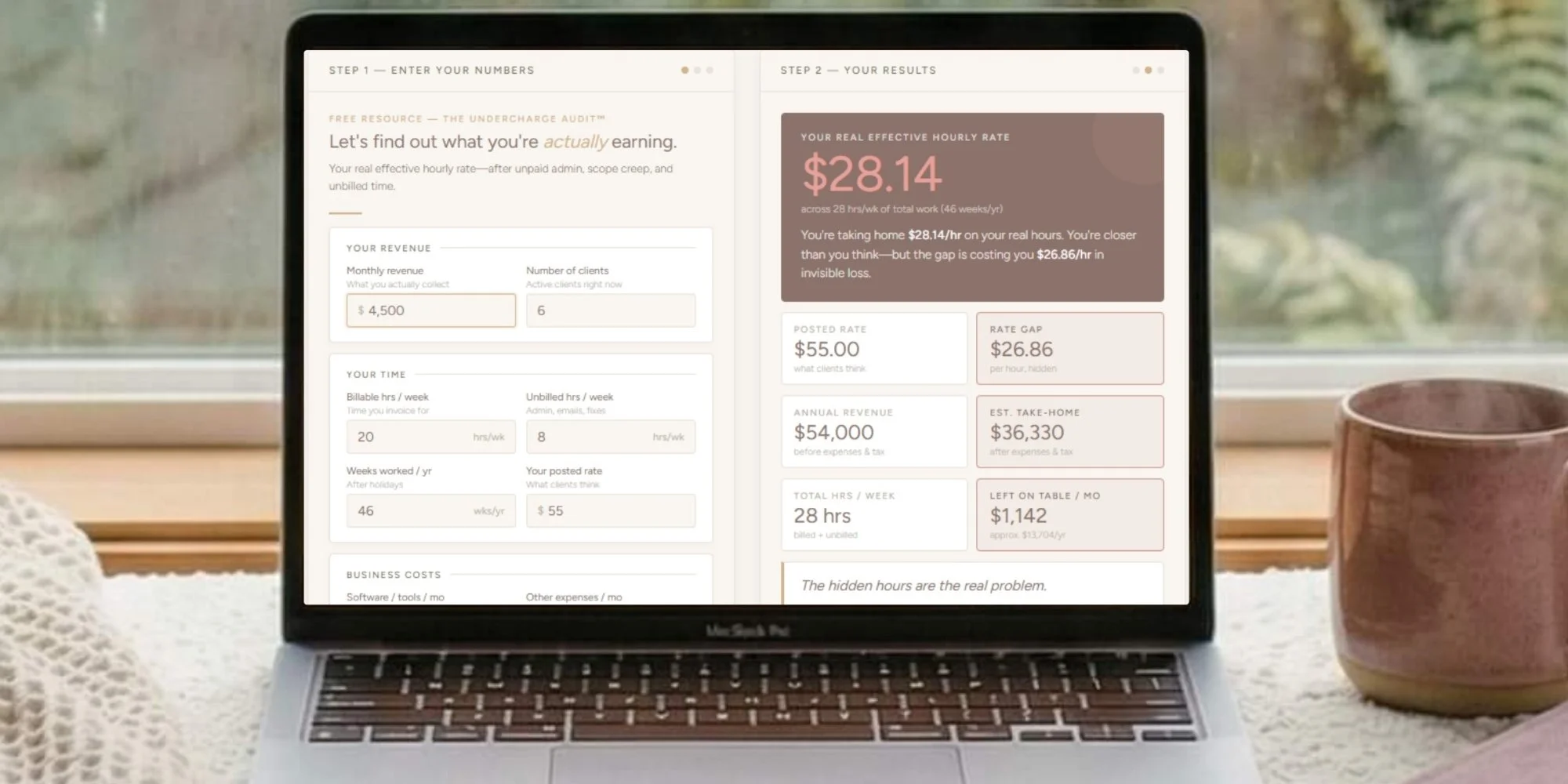
The Undercharge Audit
The Undercharge Audit is a free interactive calculator built specifically for this. You enter your actual numbers: monthly revenue, number of clients, billable hours per week, the hours you're working but not billing, your business expenses, and your estimated tax rate. The tool runs the math and shows you your real effective hourly rate, along with the gap between that number and your posted rate.
It takes about five minutes. The number it gives you is often uncomfortable. That's the point. A vague sense that something is off doesn't move you to act. A specific dollar figure usually does.
If your bookkeeping rate feels too low, something real is driving that. But the fix is almost never as simple as a higher number on your next invoice. Understanding where the time, the margin, and the structure are actually going is what puts you in a position to make changes that hold. That's what a profitable, sustainable practice is built on.